The 1798 Wexford Rising claim
Evidence for and against Thomas McKenna (1772–1835) as a combatant in the Wexford / Wicklow rising.
Current conclusion · 13 May 2026
Short Answer
The 1798 story is a strong family tradition, not yet a documented historical identification. The current evidence says this: the stone photograph reads Tipperary, but four family-memory channels preserve Wexford. The newly embedded Philip J. McKenna II audio gives the cleanest reconciliation so far: Thomas fought or was wanted in Wexford, fled to Thurles, Co. Tipperary, met Jane Foulkes there while under shelter, then went west/north after the elopement. Published Tipperary searches and the new 11 June 2026 public-OCR Wexford pass have both been negative for a target Thomas McKenna/Kenna. The Ballyellis anecdote is weak, and both Wexford and Tipperary remain in scope until a primary rebel, prison, military, or local-paper record resolves the conflict.
Best current reading
Treat Thomas as a claimed 1798 participant with meaningful family evidence, but do not state a county or battle as proven.
Research stance
The next useful work is not another retelling; it is targeted prosopography and primary-index work in Wexford, Tipperary, Yeomanry, and north-Kerry sources.
Best Evidence
- Proven
The family-supplied stone photograph reads 1798 REBELLION TIPPERARY.
- Likely
Four independent family-memory channels preserve a Wexford version: Donald James McKenna, Roche 1998, Bryan Mac Mahon/Listowel, and Irish Life and Lore.
- Possible
Philip J. McKenna II's interview makes Tipperary a route / refuge / elopement place: Thomas flees Wexford to Thurles, where Jane shelters him. This may explain why the stone says Tipperary even if the rebellion memory says Wexford.
- Negative
The 11 June 2026 public OCR pass over major Wexford 1798 sources did not find target Thomas McKenna/Kenna. Checked sources include Hay, Wheeler/Broadley, Cloney, Taylor, Musgrave, Miles Byrne, Charles Jackson, Musgrave's Wexford massacre pamphlet, and Grogan attainder evidence.
raw/evidence/internetarchive-wexford-1798-ocr-kenna-pass-2026-06-11.md - Negative
The published Tipperary corpora checked so far contain no McKenna or Foulkes match.
- Negative
Roche's specific Ballyellis / Holt / Cullen identification does not survive the O'Donnell Wicklow-register check.
- Done
The Irish Life and Lore recording is now locally saved and transcribed; it preserves the Wexford, Bantry, wounded-hand, and Ballyduhig family-memory wording in Jack and Sue McKenna's interview.
Next Targets
- Done
Purchase or access Irish Life and Lore CD191602-129 and transcribe the 1798 passage.Done 26 May 2026: local MP3 and machine transcript saved atraw/jack-sue-mckenna-listowel.mp3andraw/jack-sue-mckenna-listowel-transcript-2026-05-26.md. - OpenCheck Daniel Gahan, The People's Rising: Wexford 1798, William Sweetman's 1798 trial transcripts, and any Wexford 1798 museum/database name files for Thomas / Kenna / McKenna variants. The public Internet Archive OCR layer is now checked and negative.
- OpenSearch Thurles / south-Tipperary refuge, marriage, and Yeomanry leads for a Foulkes household or officer who could have sheltered Jane in 1798–1800.
- OpenUse NAI Bishop Street SOC/Tipperary and Wexford card indexes when on-site access is available.
- OpenSearch Yeomanry pay lists and commission notices for Foulkes / Ffoulkes officers.
- OpenLook for a contemporary 1835 death notice, earlier grave survey, or Hegarty documentation explaining the 1958 inscription.
Evidence Log
The claim, in its family-oral form
[Thomas McKenna] "led an uprising against the English in 1798 in the County of Wexford" — and fled south, meeting Jane Foulkes ("Lady Jane, daughter of the English Captain") before they both made their way to Kerry.
— Donald James McKenna (b. 1953), Family History (
raw/family-history-donald-mckenna-1953.md)
The Philip J. McKenna II interview, now embedded on John M. McKenna I's page, is more geographically precise than the shorter written summaries: Thomas is said to flee from the Wexford area to Thurles, Co. Tipperary, where Jane gives him shelter; only after they fall in love and elope do they go west/north toward the Shannon. That makes Tipperary the meeting place in this telling, not necessarily the rebellion theatre.
That claim had been flagged in earlier versions of this wiki as family legend — plausible on dates (Thomas was 26 in 1798, a combat-eligible age) but unverified against any external record. As of April 2026 that picture has changed: independent external corroboration of the same story exists, published in 1998 on the bicentenary of the rising, and it names the same couple (Thomas McKenna, Jane Foulkes) with the same death years (1835 / 1840). What this page does is weigh that corroboration against the most complete modern register of identified rebels, and decide what can and cannot be said responsibly.
The independent external source: Richard Roche, Irish Times, 1998
Richard Roche — a Co. Wexford local historian — published a column in the Irish Times's "An Irishman's Diary" on 11 August 1998 identifying the "brave United Irishman" and "Captain's daughter" of Robert Dwyer Joyce's ballad The Boys of Wexford as two real people: Thomas McKenna and Jane Foulkes. Working transcript and analysis: raw/irish-times-richard-roche-1998-brave-united-irishman.md. User-supplied article copy: raw/thomas mckenna article by richard roche.docx.
Roche's material comes from two living informants in 1998:
- Mrs Sue McKenna, of Parknadoon, Listowel — her husband Jack McKenna is described as "a direct descendant of the 'brave United Irishman'". Jack would be a 4th- or 5th-generation descendant of Thomas McKenna (1772–1835), in a different branch from Donald James McKenna (b. 1953) who is the user's line.
- Antoinette Dunphy (née Leahy), of Piltown, Co. Kilkenny — a Leahy-line descendant who is also a great-granddaughter of Maurice Davin (1842–1927), co-founder and first president of the GAA.
Two points of particular weight in Roche's column:
- A physical gravestone. Roche writes that the couple are "buried in the Hegarty plot (belonging to other descendants) in Kilsynan graveyard where a tombstone refers to Thomas as an insurgent in Wexford in 1798." "Kilsynan" is Roche's spelling; compare our Kerry & Foynes descendants page, where the gravestone location is transcribed as Kilshenane (Lixnaw / Listowel area), matching the Donald James McKenna family history. The spellings "Kilsynan" / "Kilshenane" / "Kilshinane" are local variants of the same north-Kerry townland. The family-supplied Ireland-visit photos include one site that is almost certainly this graveyard.
- Family names in two new directions. Roche names four children — Thomas, Edmond, James, Mary — where Peter Terren's Geneanet tree has only James. And Roche extends the descendant surnames to McKennas, Leahys, O'Connors, Bartons, Browns and Danaghers. These are leads to collateral cousin lines that have not yet been followed.
The weak link: the Ballyellis anecdote
Roche adds a speculative identification: "It has also been suggested that Thomas McKenna or Kenna may be the man mentioned in Joseph Holt's memoirs and in Brother Luke Cullen's folk records, fighting as an insurgent in Co Wicklow. Holt and Cullen mention Kenna as receiving a severe wound to the hand at the battle of Ballyellis on June 30th, 1798." The anecdote continues that insurgent leader Edward Roche of Garrylough, Co. Wexford accidentally inflicted the wound with a backhanded sword cut, and that despite the wound "Kenna" swore to follow Roche.
On retrieval, this anecdote does not survive end-to-end scrutiny:
- Joseph Holt's Memoirs (London, 1838), Internet Archive full-text (vol. I, vol. II) has been grepped for the surnames Kenna / McKenna / M'Kenna. No match appears in either volume. Holt's Ballyellis chapter (vol. I, pp. 78–93) does not name Kenna. The wounded-by-a-backhand-sword-cut story is not there. Roche's 1998 attribution of the anecdote to Holt's memoirs is either an error or a reference to an OCR-resistant spelling variant — but no plausible variant returns a hit.
- Brother Luke Cullen's manuscript folk-memory accounts (TCD MS 1472; NAI M 5892a; NLI MS 8339, 9760-2) are not digitised. However, the 1948 Myles V. Ronan edition (Insurgent Wicklow 1798) and, most importantly, Ruan O'Donnell's The Rebellion in Wicklow 1798 (Irish Academic Press, 1998) — which contains an appendix of almost 1,000 identified Wicklow United Irishmen compiled directly from Cullen, the Rebellion Papers, and allied primary sources — together constitute the best modern register of identified rebels from the Wicklow / Wexford-border theatre. That register is searchable as a CGI database at Peter May's Wicklow Rebels site (pcug.org.au/~ppmay/wicklow.htm).
raw/wicklow-united-irishmen-odonnell-database.mdrecords our searches.
The O'Donnell register returns, across all surname variants:
McKenna— 0 recordsM'Kenna— 0 recordsKenna— 1 record: forename "Not Given", native place Stratford (i.e. Stratford-on-Slaney, Co. Wicklow)%K%nna%(wildcard) — 1 record (the same Stratford Kenna)- Native place
%Monaghan%— 0 records
That is: the canonical Wicklow rebel register has one Kenna, a Wicklow native, and no McKennas of any origin. If the "Kenna" in Cullen's manuscript is the Stratford-on-Slaney man, then (a) Roche's tentative identification of him with our Thomas McKenna of Castleblayney, Co. Monaghan is almost certainly wrong; (b) the specific Ballyellis / backhand-sword-cut anecdote in the 1998 column is about a different man entirely; and (c) Roche himself flagged it as a "suggestion" rather than a fact.
What is left standing
The Ballyellis identification collapses under the O'Donnell register. But two other sources in Roche's 1998 column — independent of Holt/Cullen — survive the test:
- The Kilshenane tombstone. A stone that "refers to Thomas as an insurgent in Wexford in 1798" is a physical artefact, in a named graveyard, in the burial parish of Thomas's known descendants. Roche reports it on the basis of Bryan MacMahon's personal knowledge and descendant-family testimony. This is inspectable on site; it is also (in principle) photographable from existing headstone surveys of Kilshenane / Kilsynan. Whether the inscription was cut in 1835 (Thomas's death) or later — and what exactly it says — are the critical unknowns; the Irish Times column does not give the wording or the date of the inscription.
- Two-branch family tradition. The Sue McKenna (Parknadoon, Listowel) line and the Donald James McKenna (Washington / Foynes) line share independently the same 1798 story. Sue's line descends through one of the Listowel children; Donald's descends through Philip Joseph McKenna of the Foynes Model Farm (born 1862). Two separate branches preserving the same 1798-Wexford claim is evidence that the claim was in family circulation by the mid-late 19th century — i.e. within living memory of the rising — rather than being a 20th-century invention.
That combination — physical gravestone plus two-branch oral tradition — is enough to treat the Wexford-rising claim as a plausible family memory that may be historically grounded, even without a named entry in Holt/Cullen/O'Donnell. It is not enough to assert as a documented historical fact.
May 2026 update — the stone says Tipperary, not Wexford
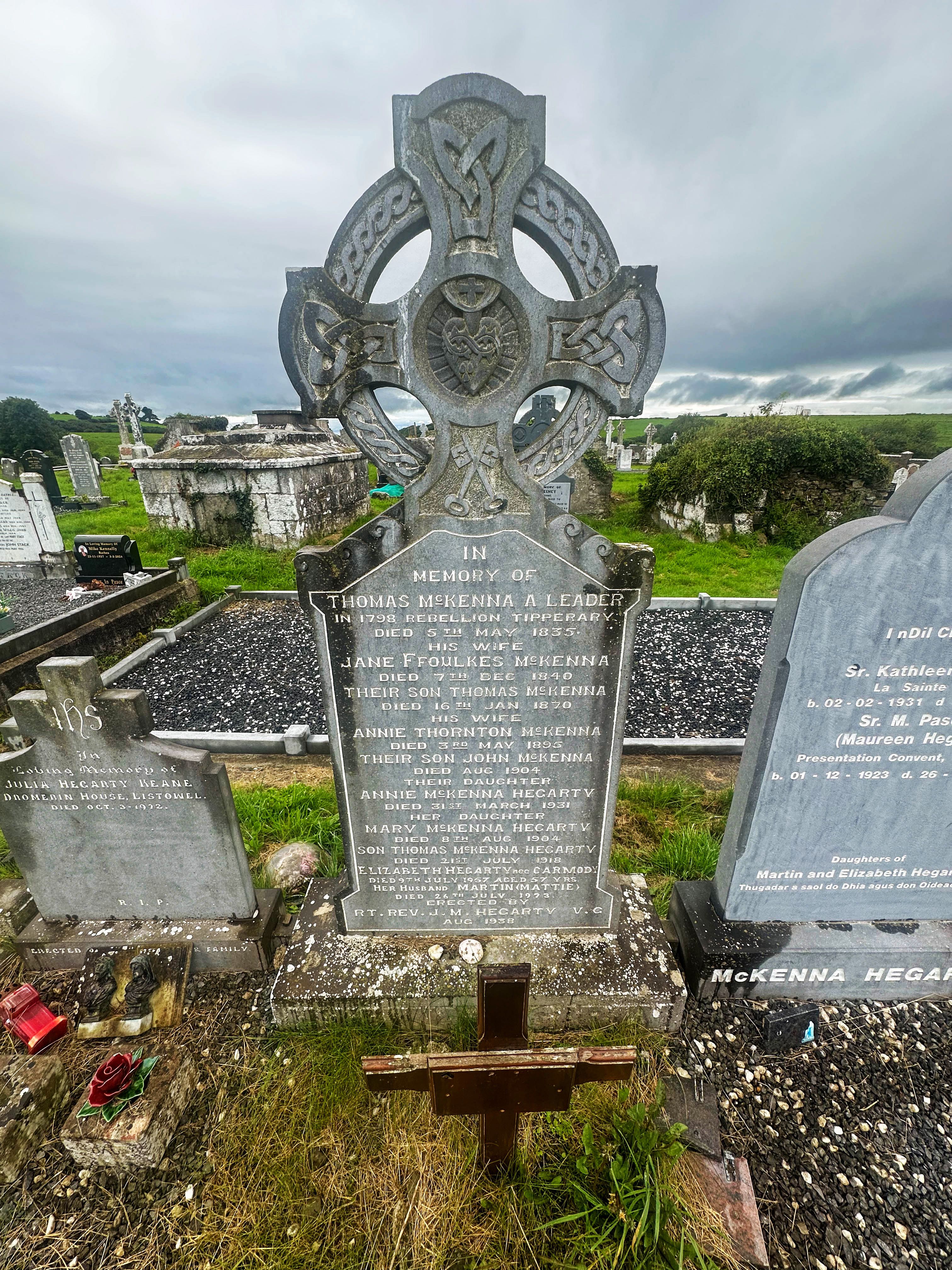
A high-resolution photograph supplied by the user in May 2026 settles the question that the previous version of this page had treated as an open three-way discrepancy. The opening line of the inscription, in legible capitals, is:
THOMAS McKENNA A LEADER
IN 1798 REBELLION TIPPERARY
DIED 5TH MAY 1835
Three secondary sources had previously disagreed about what the stone says — Roche 1998 ("Wexford"), Mac Mahon's blog ("Vinegar Hill" = Wexford), and the dalyskennelly2000.jimdofree.com transcription ("Tipperary"). The photograph confirms that the jimdo transcription was correct. Roche's Irish Times column was wrong on this detail. Either he misread the stone on a single visit, mis-recalled it, or paraphrased it through the famous ballad The Boys of Wexford. Mac Mahon's "Vinegar Hill" gloss is family-oral conflation with the better-known Wexford theatre.
This is the single biggest course-correction since the wiki began. Three knock-on consequences:
- The 1798 search corpus shifts from Wexford to Tipperary. Wexford-specific registers — Daniel Gahan's The People's Rising: Wexford 1798, Pakenham's The Year of Liberty, the O'Donnell Wicklow corpus — are now the wrong shelves. The right ones are: NAI Rebellion Papers SOC/Tipperary series; Thomas Bartlett, The 1798 Rebellion (2003) Tipperary indexes; and any surviving Tipperary Yeomanry / militia muster rolls. Tipperary's '98 was largely pre-emptive — mass arrests, transportations, and martial-law summary executions — rather than the pitched battles of Wexford. A "leader" caught in this phase would be in court-martial dockets and prisoner returns, not in a battle order. The Ballyellis / Edward-Roche anecdote was always a long shot; it can now be retired completely.
- The "Yeomanry captain Foulkes" question gains a county. If Thomas's rebellion was Tipperary, the obvious place to look for Jane's "captain of the Yeos" father is the Tipperary Yeomanry corps lists 1796–1803 — Cashel, Clonmel, Cahir, Carrick-on-Suir, Tipperary-town corps — rather than Wexford or Wicklow. The April 2026 deep-search iteration 2 ruled out a Foulkes regular-Army officer in the 1816 / 1817 Army Lists; it did not rule out a Foulkes Yeomanry officer in Tipperary.
- The Foulkes-Tipperary identification is partially re-opened. The April 2026 hypothesis-test file ruled out a landed Tipperary Foulkes family on negative Bassett-1889 / Burke / Landed-Estates evidence. But a non-landed Tipperary Foulkes presence (a Cromwellian-stock yeoman, a strong-farmer Yeomanry officer, an urban-trade Clonmel family) would not appear in those sources and would be consistent with Roche's speculation, the Killererin Heritage "Jane from south Tipperary" claim, and the stone wording. A south-Tipperary parish-by-parish CofI sweep for Foulkes 1750–1800 — Clonmel St Mary's, Cahir, Carrick-on-Suir, Tipperary town — is now justified.
One nuance: the stone's footer dates the present inscription to August 1958 ("Rt. Rev. J. M. Hegarty V.G. Aug 1958" — the Vicar General who erected or re-cut it). The Tipperary wording is therefore not 1835-contemporary but 1958-family-memory, four or five generations on from Thomas himself. That weakens the stone as primary evidence for what Thomas actually did in 1798. But it raises a sharper question: the Tipperary wording on a 1958 stone disagrees with what the Sue-McKenna-line and Donald-James-McKenna-line family memory was independently saying about the 1798 episode. The wording on the stone is one channel; the surviving oral tradition is another.
May 2026 follow-up — the four Wexford channels and the lone Tipperary outlier
A second May 2026 register-coverage pass (raw/lixnaw-listowel-register-coverage-2026-05.md) located a previously-uncited primary source: Irish Life and Lore audio recording CD191602-129, an oral-history interview with Jack McKenna (b. 1918) and his wife Sue McKenna of Parknadoon, recorded by Maurice O'Keeffe. The local MP3 and machine transcript are now saved at raw/jack-sue-mckenna-listowel.mp3 and raw/jack-sue-mckenna-listowel-transcript-2026-05-26.md. The product-page show notes describe its content as covering John J. McKenna and tracing the family back to "Thomas McKenna who went from Monaghan to Wexford in 1798 to fight in the Rebellion."
This is the same Sue McKenna Roche used as his 1998 informant. The audio therefore preserves, in a separate medium, the same family-tradition wording she gave Roche. Combined with the other channels, the inventory now stands at four independent family-memory channels saying Wexford, against one 1958 inscription saying Tipperary.
The May 8 2026 retrieval of the full audio show notes (saved at raw/Jack McKenna (b. 1918) and Sue McKenna | Irish Life & Lore.html) extends the audio's family-tradition account beyond the bare "Wexford" attribution into a richer narrative:
"John Joseph McKenna was a descendant of Thomas McKenna who went from Monaghan to Wexford in 1798 to fight in the Rebellion. When it failed, he travelled to Bantry to meet the French invasion, which was aborted. Wounded in the hand and on the run, he intended returning to Monaghan, but made the decision to settle in Ballyduhig, close to Listowel in Co. Kerry."
Two new substantive details:
- "Bantry to meet the French invasion, which was aborted" — the most likely historical referent is the December 1796 Bantry Bay French expedition under Lazare Hoche, which arrived at Bantry Bay but was scattered by storms and never landed. (The other French landings of the period are Killala 1798 — opposite coast — and the small Tone landing at Lough Swilly 1798 — also opposite.) For Thomas to "travel to Bantry to meet the French invasion" implies either family-memory chronological compression (Thomas at Wexford 1798, then Bantry hoping for a fresh French landing in 1798–99 that never came) or reverse chronology (Thomas at Bantry 1796 as a Wolfe-Tone-era United Irishman, then at Wexford 1798). Neither is documented; both are family memory. Bantry is otherwise unattested in the McKenna corpus.
- "Wounded in the hand" — independently corroborates Roche's 1998 attribution of a hand-wound to Thomas. Roche's specific Ballyellis identification of the hand-wound (via a misattribution to Holt's Memoirs, refuted above by O'Donnell's Wicklow register) was wrong. But the family memory of "wounded in the hand" itself is now seen to predate Roche's 1998 column — it is in the Sue / Jack McKenna oral history transmitted from John J. McKenna's living account (he died in the 1950s, and the recording is post-2010). So the hand-wound itself is older family memory, not a Roche-1998 retrofit; only Roche's specific Ballyellis attribution was wrong. The actual location and circumstance of the wound remain unknown.
The full Wexford-channels inventory now stands as:
| Channel | Date | Wording | Source |
|---|---|---|---|
| Donald James McKenna family-history docx | 1953 (with 2003 / 2008 visit notes) | "led an uprising in 1798 in the County of Wexford" | raw/family-history-donald-mckenna-1953.md |
| Richard Roche, Irish Times column | 11 Aug 1998 | "insurgent in Wexford in 1798" (drawing on Sue McKenna) | raw/irish-times-richard-roche-1998-brave-united-irishman.md |
| Bryan Mac Mahon, Listowel Connection blog | 2010s | "the disaster of Vinegar Hill" (= Wexford) | listowelconnection.com |
| Irish Life and Lore audio CD191602-129 | 2010s (Maurice O'Keeffe interview with Jack & Sue McKenna) | "Thomas McKenna who went from Monaghan to Wexford in 1798 to fight in the Rebellion" | local transcript; irishlifeandlore.com |
| Kilshenane / Kilsynan headstone | August 1958 (Rt. Rev. J. M. Hegarty V.G.) | "1798 REBELLION TIPPERARY" | raw/evidence/thomas-mckenna-1772-kilshenane-headstone-proof-2026-06-10.md |
Both branches of the diaspora family — Sue McKenna's Listowel-Parknadoon line (independently sampled in 1998 and again in the audio) and Donald James McKenna's Foynes / Walter-Reed line — preserve the same Wexford reading. The stone alone has Tipperary. The earlier May 2026 hypothesis on this page (that the Wexford gloss was a 20th-century ballad-driven retrofit on top of an older Tipperary memory) is now weakened: it required Donald-James-McKenna and Roche to be drawing on a recent, ballad-influenced layer of memory, but the Irish Life and Lore audio shows Sue McKenna's family memory consistently giving Wexford across at least two interviews twenty years apart, and the Donald-James-McKenna 1953 docx pre-dates Roche by 45 years. Wexford is the cross-generational, cross-branch family memory; Tipperary is the inscription on a 1958 re-cut stone.
Why Rev. J. M. Hegarty cut "Tipperary" rather than "Wexford" in 1958 is now the open question. Plausible explanations, with the evidence as currently weighted:
- Rev Hegarty had access to a separate documentary fragment naming Tipperary that has not survived. Possible. He was Vicar General — institutional access. But no such document has surfaced.
- An earlier, illegible or eroded stone said Tipperary, and Hegarty was reading it as best he could. Possible. If the original 1835 stone was still present in 1958, it would have been 123 years old and could have been unreadable in places. Tipperary and Wexford both end in "-ord" / "-ary" but are not particularly easy to confuse on a stone — different syllable counts.
- Hegarty was deliberately substituting a less-romanticised location to undercut the "Boys of Wexford" ballad tradition that the family had attached to Thomas. Speculative. Would imply a 1958 cleric pushing back against an older folk-romantic accretion.
- Confusion or conflation with Philip Cunningham of Moyvane, the documented Listowel-area Tipperary-1798 figure (born 1770 in Moyvane near Listowel; led the Clonmel United Irish; transported on the Anne 1800; led the 1804 Castle Hill / "Vinegar Hill" rising at Parramatta NSW — see the May 5 leads-chase). If a local Listowel cleric in 1958 was working from local memory of "the 1798 leader from Moyvane / Listowel who became famous", he could have absorbed Cunningham's Tipperary career into the McKenna inscription. The Cunningham–McKenna conflation is geographically and chronologically plausible: same parish complex, same decade.
None of these is established; the question is currently open.
The substantive consequence is that the 1798 search corpus does not shift cleanly from Wexford to Tipperary as the May 5 reading implied. Both county-corpora are now in scope: a Tipperary search (the 1958 stone) and a Wexford search (the four family-memory channels). The May 5 leads-chase tested all three tractable Tipperary online routes and produced negatives. The Wexford-side prosopographical apparatus — Daniel Gahan, The People's Rising: Wexford 1798 (1995), Thomas Pakenham's The Year of Liberty (1969 / 2000), and the Wexford 1798 Bicentenary database — is therefore back at the top of the on-site / paid reading list rather than retired as wrong-county work.
The Yeomanry-captain / Jane Foulkes angle
Roche's 1998 column also records that Jane Foulkes was "the daughter of the captain of the Yeos" — i.e. a Yeomanry captain. This is independent corroboration of the Donald James McKenna docx's "Lady Jane… daughter of the English Captain" tradition. "Yeos" in 1798 Irish context means the Irish Yeomanry — a Crown paramilitary militia raised from 1796, in which local gentry (often Protestant) served as officers. A Yeomanry-captain father would be historically plausible; the scandal of a Yeomanry captain's daughter eloping with a wanted Catholic insurgent is exactly the sort of story a family would preserve for generations.
However, Roche's column then complicates the geography: the Foulkes family it places in the Wexford / Tipperary / Kilkenny area are the Clonmel and Piltown Foulkeses, Cromwellian in origin, with a Simon Foulkes sitting on the March 1766 Clonmel jury that hanged Fr Nicholas Sheehy. This is a different family cluster from the reported Welsh / Welsh-border Jane lane in Peter Terren's Geneanet tree, where her father is given as Thomas Foulkes dying at Shrewsbury in 1816. Either Peter Terren has the wrong Jane Foulkes, or the Tipperary Foulkeses and the Welsh-border Foulkeses are the same extended family. This needs Foulkes-side primary work; see Jane Foulkes.
May 2026 leads-chase — three Tipperary leads, three negatives
A focused May 2026 pass tested all three tractable Tipperary routes opened by the gravestone wording. Full details at raw/tipperary-leads-chase-2026-05.md; the three published Tipperary 1798 papers retrieved are saved alongside as raw/tipperary-courtmartials-1798-1801.pdf (Power 1993), raw/okeeffe-1990-1798-south-tipperary.pdf (O'Keeffe 1990), and raw/odonnell-1998-philip-cunningham-clonmel.pdf (O'Donnell 1998).
- Lead 1 — Tipperary 1798 prisoner / courtmartial corpora: zero McKenna, zero Foulkes. Patrick C. Power's "Tipperary Courtmartials: 1798–1801" (Tipperary Historical Journal 1993) is the published index drawing directly on the Rebellion Papers 620 series. Plain-text grep returns no match for any spelling variant of McKenna / Mc Kenna / M'Kenna / Kenna or Foulkes / Ffoulkes / Foulke. Diarmuid O'Keeffe's "1798 in South Tipperary" (THJ 1990) — the canonical narrative survey of every documented disturbance — likewise contains zero matches. Ruan O'Donnell's biographical study of Philip Cunningham, the documented Clonmel insurgent leader of 1798 (THJ 1998), names every Cunningham associate, court-martial witness, transportee on the Anne, and Castle Hill participant; no McKenna or Foulkes anywhere. The 1798 Centre rebellion-leaders database also returns zero. The NAI Rebellion Papers card indexes themselves are not digitised and remain accessible only on-site at NAI Bishop Street, Dublin — but the published works that draw on them are now exhausted.
- Lead 2 — Tipperary Yeomanry corps officers: no Captain Foulkes. Eleven Tipperary Yeomanry corps are now identified by name (Tipperary Yeomen Cavalry under Col. Francis Massey; Clanwilliam Corps; Cashel Yeomanry under Col. Deering; Clonmel Yeomen Cavalry; Carrick-on-Suir Yeomen; Upperthird Cavalry; Templemore Yeomanry Cavalry; Tipperary Infantry Yeomanry under Cpl. William Lamphier; Clogheen Yeomanry under Lt. Prendergast; Pennefather's Troop at Newport; Hutchinson's Yeomanry under Francis Hutchinson, brother of Lord Donoughmore). Named officers across all corpora include Massey, Deering, Lamphier, Prendergast, Hutchinson, Pennefather, and Otway Toler (Tipperary Brigade Major). None is a Foulkes. The April 2026 hypothesis-test had already ruled out a Foulkes regular-Army officer in the Army Lists 1816/1817; this round adds the Tipperary Yeomanry corps without surfacing one. The unread primary sources remain TNA WO 13 (Yeomanry pay lists), PRONI Yeomanry papers, and the Hibernian Journal 1796–1803 commission notices — all paid or on-site only.
- Lead 3 — South-Tipperary Foulkes residency: triple-negative. Bassett's 1885 Wexford and Bassett's 1889 Tipperary directories both contain zero Foulkes households. The 1901 / 1911 Ireland censuses (NAI search) return zero Foulkes households in County Tipperary. John Grenham's surname-finder snippet describes Foulkes as "primarily concentrated in Cork and Dublin counties, with the most significant presence appearing in Dublin" — Tipperary is not on the concentration list. There is no documentary trace of a Foulkes line resident in Tipperary in the 19th or early 20th century. The Welsh-border Foulkes identification (Peter Terren / Geneanet, father d. 1816 Shrewsbury, mother b. Chester) therefore remains the documentary-stronger reading; the Tipperary suggestion in Roche 1998 and the gravestone "Tipperary rebellion" wording do not, on this evidence, also imply a Tipperary Foulkes family.
Striking incidental find: the May 2026 read of O'Donnell 1998 reveals that Philip Cunningham, the documented Clonmel United Irish leader of 1798, was born at Moyvane near Listowel, Co. Kerry, in 1770 — the same north-Kerry parish complex where the McKennas later settled. Cunningham moved to Clonmel as a young man, ran a public-house, married locally in February 1798, was court-martialled at Clonmel October 1799, transported on the Anne in 1800 with two other Kerry/West-Limerick United Irishmen (Manus Sheehy, nephew of Fr Nicholas Sheehy of 1761; Thomas "Captain Steel" Langan), and led the 1804 Castle Hill convict rising at Parramatta, NSW — which the Irish convicts there renamed "Vinegar Hill" in honour of the 1798 Wexford battle. The Listowel/Moyvane–Clonmel–Tipperary–1798 axis is therefore historically real through Cunningham; it just doesn't (yet) include Thomas McKenna.
For our purposes the practical implication is that the family-oral memory of a "1798 in Tipperary" connection is not absurd given Cunningham's documented existence — a 1772-born Monaghan Thomas McKenna who fought in Tipperary in 1798 and ended up in north Kerry a few years later sits in exactly the network Cunningham did. But it remains a family memory, not a document; the May 2026 leads-chase did not produce a Thomas McKenna match in any published Tipperary 1798 corpus.
Open questions and next actions (May 2026 update)
Photograph the Kilshenane tombstone.Done — May 2026. Stone reads "1798 REBELLION TIPPERARY". The 1958 footer (Rt. Rev. J. M. Hegarty V.G.) means the engraving is not 1835-contemporary; an earlier headstone-survey rubbing or local-paper death-notice from May 1835 would be the next step toward a contemporary primary source.Search the published Tipperary 1798 corpora for Thomas McKenna.Done — May 2026: zero matches in Power 1993, O'Keeffe 1990, O'Donnell 1998, or the 1798 Centre database. The remaining route is the physical NAI Bishop Street card-index for SOC/Tipperary, plus the Wexford SOC card index (the gloss-of-record), plus Daniel Gahan, The People's Rising: Wexford 1798 (1995) — none of which is digitised.Search Tipperary Yeomanry corps for Captain Foulkes.Done — May 2026: 11 corps named, no Foulkes officer in any. Remaining route: TNA WO 13 (Yeomanry pay lists), PRONI Yeomanry papers, IrishNewsArchive.com Hibernian Journal back-issues 1796–1803.Search for a Tipperary Foulkes residency 1750–1900.Done — May 2026: triple-negative across Bassett 1885/1889, 1901/1911 censuses, Grenham distribution. The Welsh-border Foulkes identification stands.- Contact the Sue McKenna / Parknadoon branch in Listowel. Roche's 1998 informant. They may hold further family documents — and would be the right people to ask whether their family memory is "Wexford" or "Tipperary" or something else entirely.
- Listowel Connection / Mary Cogan — direct enquiry to the listowelconnection.com editor for any further Mac Mahon material on the McKenna / Foulkes / Troy network.
- Wexford 1798 prosopography. The 11 June 2026 Internet Archive public-OCR pass is now checked and negative for target McKenna/Kenna variants across Hay, Wheeler/Broadley, Cloney, Taylor, Musgrave, Miles Byrne, Charles Jackson, and related pamphlets. Still open: Daniel Gahan, The People's Rising: Wexford 1798 (1995), William Sweetman's trial transcripts, Thomas Pakenham's The Year of Liberty index, NAI Rebellion Papers card indexes, and any Wexford 1798 Bicentenary/heritage-centre name files.
- North Kerry RC baptisms 1798–1820. NLI register coverage (May 2026 follow-up,
raw/lixnaw-listowel-register-coverage-2026-05.md) shows: Lixnaw baptisms only start 4 Aug 1810; Listowel from 3 Aug 1802; Causeway from 4 Nov 1806 (with a 1782–86 stub); Duagh from 1819. Patrick is uncertain because FamilySearch gives 1799-1800 while Find a Grave gives 1802; only a late-1802 Listowel-area baptism would fall within surviving coverage. Mary (1804) is reachable only at Listowel. Elizabeth (1810), James (1810), Gerald (1816), and Jane (1820) are reachable across one or more of Lixnaw/Listowel/Causeway/Duagh depending residence. The actual indexed search on irishgenealogy.ie / rootsireland.ie is currently Cloudflare-blocked against automated retrieval — needs a human browser session or a paid rootsireland.ie subscription. - Irish Life and Lore CD191602-129 is now purchased and transcribed. Local MP3 and machine transcript are saved at
raw/jack-sue-mckenna-listowel.mp3andraw/jack-sue-mckenna-listowel-transcript-2026-05-26.md. Next step: verify the 1798 passage and BMH passages against the audio before exact quotation.
Primary sources for this page: Richard Roche, "An Irishman's Diary", Irish Times, 11 August 1998 (raw/irish-times-richard-roche-1998-brave-united-irishman.md; user-supplied article copy at raw/thomas mckenna article by richard roche.docx); Ruan O'Donnell's Wicklow United Irishmen register via Peter May's CGI (raw/wicklow-united-irishmen-odonnell-database.md); Joseph Holt, Memoirs (London, 1838) Internet Archive full-text, negative search; the 11 June 2026 Internet Archive Wexford OCR pass (raw/evidence/internetarchive-wexford-1798-ocr-kenna-pass-2026-06-11.md); Donald James McKenna (b. 1953) family history docx (raw/family-history-donald-mckenna-1953.md).