John Joseph McKenna (1875–1950s)
Listowel hardware-and-timber merchant; founding member of the Listowel Volunteers (1913); Easter Rising 1916 messenger; Chairman of Kerry County Council; court-martialled at Cork and imprisoned in Belfast for concealing arms during the War of Independence; descendant of Thomas McKenna of 1798. Father of Jack McKenna (1918–c.2019).
Current conclusion · 13 May 2026
Short Answer
John Joseph McKenna is both a historically significant Listowel figure and a key carrier of the Thomas-McKenna-1798 family tradition. His connection to Thomas's line is strong through the Irish Life and Lore audio and the Listowel business family, but the exact placement of Jeremiah's father John M'Kenna within the Ballyduhig / Kilshenane family still needs proof.
Best current reading
The audio preserves the richest Wexford / Bantry / wounded-hand version of the family story, while John Joseph's own public life anchors this branch in documented Irish revolutionary history.
Research stance
Separate two questions: John Joseph's historical career is well framed; the exact Gen 3 John M'Kenna identification remains open.
Best Evidence
- Proven
The Irish Life and Lore show notes identify John Joseph as part of the Thomas McKenna descendant tradition and preserve the Wexford version.
- Proven
The 1871 civil marriage copy names Jeremiah McKenna's father as John M'Kenna, labourer.
- Likely
The Listowel business line, Parknadoon oral-history branch, and McKenna's Mill material belong to the same north-Kerry descendant network.
- Open
Which John M'Kenna fathered Jeremiah remains the central genealogical gap for this page.
Next Targets
- OpenFind John Joseph McKenna's Bureau of Military History witness statement.
- OpenRetrieve Jeremiah McKenna's baptism c. 1844 and any matching John M'Kenna residence clues.
- OpenTrace Ennismore, Ballyduhig, and Kilshenane valuation-revision books for John / Jeremiah succession.
- OpenLocate Austin Stack's Belfast Prison letter and any related Stack/McKenna papers.
Evidence Log
Audio and transcript
Irish Life and Lore CD191602-129 — Jack McKenna and Sue McKenna. Local MP3, 44:55, transcribed 26 May 2026.
raw/jack-sue-mckenna-listowel-transcript-2026-05-26.md is the readable timestamped machine transcript. raw/jack-sue-mckenna-listowel-transcript-2026-05-26.json preserves the raw segment timings.
The transcript is a finding aid, not an exact scholarly quotation. Check proper names, placenames, newspaper readings, and low-volume passages against the MP3 before citing the wording.
Why he is on the wiki
John Joseph McKenna sits at three intersections that make him historically and genealogically central:
- He is the strongest single proponent of the family-tradition Wexford-1798 narrative — the show notes for the Irish Life and Lore audio recording CD191602-129 open with: "John Joseph McKenna was a descendant of Thomas McKenna who went from Monaghan to Wexford in 1798 to fight in the Rebellion." This is recorded in his son Jack's voice and his daughter-in-law Sue's voice, transmitted from Jack's father's living memory. It is the longest-form family-memory account of the 1798 episode that has survived. See the 1798 page for the analytical comparison of all four family-memory channels (this audio plus the 1953 docx, Roche 1998, and Mac Mahon's blog) against the 1958 stone.
- He is a substantive 20th-century Irish historical figure in his own right — founder/treasurer of the Listowel branch of the Irish Volunteers (founded 1913); arms-harbouring at McKenna's Mill yard; messenger for the 1916 Rising (sent home from Dublin when discovered to be married); led the Kerry county-level taking of Lord Listowel's lands for vegetable growing during the War of Independence; Chairman of Kerry County Council when arrested; court-martialled in Cork; imprisoned in Belfast for concealing arms; submitted a witness statement to the Bureau of Military History; buried with full military honours.
- He is a proven Listowel-descendant of the Thomas-McKenna-1772 line — confirmed by the audio recording's explicit "descendant of Thomas McKenna" framing. The chain is: Thomas (b. 1772 Monaghan, d. 1835 Kilshenane) → ... → John M'Kenna (named as Jeremiah's father on the 1871 marriage certificate) → Jeremiah McKenna (m. Johanna Horgan 17 October 1871, founded McKenna's Mill at 3 Market St, Listowel) → John Joseph McKenna (b. 1875, m. Grace McMahon 1909) → Jack McKenna (b. 1918) and his siblings. The exact identification of Jeremiah's father John within the Ballyduhig/Kilshenane McKennas is not yet fully documented; see "Open identifications" below.
The 1798 family narrative as preserved in the audio
The audio show notes (preserved verbatim at raw/Jack McKenna (b. 1918) and Sue McKenna | Irish Life & Lore.html) open with the following quoted account of the family origin:
"John Joseph McKenna was a descendant of Thomas McKenna who went from Monaghan to Wexford in 1798 to fight in the Rebellion. When it failed, he travelled to Bantry to meet the French invasion, which was aborted. Wounded in the hand and on the run, he intended returning to Monaghan, but made the decision to settle in Ballyduhig, close to Listowel in Co. Kerry."
Three substantive elements of this paragraph add to the 1798 evidence base:
- "Bantry to meet the French invasion, which was aborted" — Bantry is a new geographical detail. The most likely historical referent is the December 1796 Bantry Bay French expedition under Lazare Hoche, which arrived at Bantry Bay but was scattered by storms and could not land. (The other French landings of the period are Killala 1798 — opposite coast, Co. Mayo — and the small Tone landing at Lough Swilly 1798 — also opposite coast.) For Thomas to have "travelled to Bantry to meet the French invasion" implies either (a) family-memory chronological compression — Thomas was at Wexford in summer 1798 then went to Bantry afterwards expecting a *new* French landing that never came; or (b) a reverse chronology — Thomas went to Bantry in 1796 first, then Wexford 1798. Both are family-memory, not document. The Bantry detail is otherwise unattested.
- "Wounded in the hand" — independently corroborates Roche's 1998 column attribution of a hand-wound to Thomas. Roche had attributed it to a Joseph Holt / Brother Luke Cullen anecdote about a "Kenna" wounded by a backhand sword cut at the battle of Ballyellis (30 June 1798) by Edward Roche of Garrylough. The earlier wiki analysis showed that Roche's specific Ballyellis identification cannot be the Stratford-on-Slaney Kenna recorded in O'Donnell's Wicklow register (zero McKenna anywhere). But the family memory of "wounded in the hand" is now seen to predate Roche's column — it's in the Sue / Jack McKenna oral history transmitted from John J's living account. So the hand-wound itself is older family memory, not a Roche-1998 retrofit; only Roche's specific Ballyellis attribution was wrong.
- "Settled in Ballyduhig, close to Listowel" — confirms Ballyduhig as the original Thomas-McKenna landing point, consistent with the 1852 Griffith's Valuation entry of Thomas Ginna at Ballyduhig (his grandson Thomas-d.1870, m. Annie Thornton). See the Kerry & Foynes descendants page for the Ballyduhig=Kilshenane civil parish documentation.
His own life — from Reno return to Belfast prison
Drawing on the audio show notes and the 2011 Mary Cogan post on listowelconnection.com (McKennas of Listowel):
Family origins and emigration to Reno
John Joseph was the son of Jeremiah McKenna (m. Johanna Horgan, 17 October 1871, Listowel RC parish) who founded the McKenna hardware-and-timber business at 3 Market Street, Listowel. The civil marriage copy preserved at raw/jeremiah-mckenna-and-johanna-marriage-certificate.pdf gives Jeremiah as age 27, gardener, residence Ennismore, father John M'Kenna, labourer; Johanna is age 25, father Michael Horgan. Per the Mary Cogan post, the property was purchased in 1875 (the year of John Joseph's birth) and Jeremiah died of tuberculosis in 1880. John Joseph would therefore have been about 5 years old when his father died. His mother Johanna ran the business in the years between Jeremiah's death and John Joseph's eventual takeover.
The audio adds a striking new detail: John J's mother and her brother had been evicted from their home by the landlord Hewson. Hewson is a documented Kerry landlord surname (Sir Henry Hewson held land in north Kerry; the Hewsons of Ennismore were a notable family). The eviction would have happened in the 1860s or 1870s — before Johanna's 1871 marriage or in the early years of it. This detail explains John Joseph's later nationalism, per Jack's own framing in the recording.
John Joseph emigrated to Reno, Nevada in 1909 (the Mary Cogan post puts it at 1907; the audio says 1909 — both dates appear in the family memory), where his relatives were already running a hardware business. He returned to Ireland soon after — and on 23 February 1909 (per the Mary Cogan post timeline, in the same year as the move) married Grace McMahon. By 1912 he had acquired Enright's creamery at Listowel (subsequently the Mill Yard).
The Listowel Volunteers and the 1916 Rising
John Joseph was prominent in the founding of the Listowel branch of the Irish Volunteers at a meeting in 1913. The audio includes Jack and Sue reading verbatim from a contemporary newspaper account of that meeting. The Volunteers drilled, marched, and fundraised for rifles. John Joseph harboured guns at McKenna's Mill yard in the years 1914–16.
In April 1916 he was one of the men in north Kerry who received the message from Dublin about the impending Rising. He travelled to Dublin to take part — but was sent home when it was discovered that he was a married man. Sue notes in the recording that this rejection-on-marriage-grounds is conspicuously absent from his later Bureau of Military History witness statement.
The Lord Listowel land seizure and the Cork court-martial
During the War of Independence (1919–21), John Joseph led north-Kerry men in taking over the lands from Lord Listowel for vegetable-growing. The audio includes letters between John Joseph and Lord Listowel discussing the request to relinquish the fields, with Jack reading one of his father's letters in his own voice. John Joseph's stated view, per Jack's recollection: the landlord had no respect for the Irish and was not willing to make any sacrifice for the people. He held no anti-English feelings in general, but Sue recalled him saying "there was only one language the English understood, and that was the gun."
By the early 1920s John Joseph was Chairman of Kerry County Council. He was arrested and court-martialled in Cork on a charge of concealing arms and sentenced to twelve months' imprisonment in Belfast. He was sent home after eight months because he had become so ill in custody.
Belfast Prison and Jack's birth
While John Joseph was in Belfast Prison his wife Grace kept the McKenna business going, and in fact expanded it, although she was pregnant with their son Jack at the time. When the baby arrived his birth was celebrated in Belfast Prison with whiskey smuggled in in a Bovril bottle inside a chicken. A letter from Austin Stack survives describing a riot in the prison in which John McKenna was involved. Austin Stack was the Tralee-born senior IRA man, Cabinet Minister for Home Affairs (1919–22), Anti-Treaty in the Civil War; the Stack-McKenna letter would be in either Stack's papers (NLI MS 17,090–17,131; UCD Archives P11) or the Bureau of Military History collection.
Bureau of Military History witness statement
John Joseph submitted a witness statement to the Bureau of Military History (BMH) — the state body established 1947 to document the 1913–21 revolutionary period. The audio recording reads from the BMH letter acknowledging receipt and from the witness statement itself. The Bureau's archives are now online at militaryarchives.ie/collections/online-collections/bureau-of-military-history-1913-1921 — a search for "McKenna" + Listowel or Kerry should surface his statement (BMH WS series). This is a tractable next-step lookup.
Death and burial
On his death (date not given in the audio show notes; Mary Cogan's post puts it in the 1950s), John Joseph McKenna was buried with full military honours.
Genealogical chain — Thomas-1772 to Jack-1918
The audio explicitly frames John Joseph as a descendant of Thomas-1772, but the precise intervening generations are not stated in the show notes. The 1871 civil marriage copy now proves that Jeremiah McKenna's father was John M'Kenna, labourer. What remains open is which John this was: the strongest working candidate is the Kilshenane-gravestone John McKenna (son of Thomas McKenna d. 1870 and Annie Thornton, died August 1906 per the cert), but that still needs corroboration from baptism, death, or land records.
Working hypothesis with the available data:
- Gen 1 — Thomas McKenna (1772–1835)
- The 1798 founding ancestor. Settled at Ballyduhig, Kilshenane civil parish, Co. Kerry. m. Jane Foulkes (1778–1840).
- Gen 2 — Thomas McKenna (?–16 Jan 1870) + Annie Thornton (?–3 May 1895)
- Working placement. Thomas is the Ballyduhig farm head per the Kilshenane gravestone and the 1852 "Thomas Ginna" Griffith's entry, now identified as Ballyduhig map reference 10a. The 1871 Bessie McKenna m. John R. Troy certificate names Bessie's father as Thomas M'Kenna, farmer, of Ballyduhig, tying this generation tightly to the same farm.
- Gen 3 — John McKenna
- Named as Jeremiah's father on Jeremiah's 17 October 1871 civil marriage copy: John M'Kenna, labourer. Candidate identification: the Kilshenane-gravestone John McKenna, son of Thomas + Annie, died August 1906 per the cert. Not yet proven.
- Gen 4 — Jeremiah McKenna
- m. Johanna Horgan, Listowel RC parish, 17 October 1871. Civil copy gives age 27, occupation gardener, residence Ennismore. Founder of McKenna's Mill at 3 Market Street, Listowel (purchased 1875). Died of tuberculosis 1880. Father of John Joseph.
- Gen 5 — John Joseph McKenna (b. 1875, d. 1950s)
- Subject of this page. m. Grace McMahon, Listowel, 1909. Reno NV emigration 1909, return same year. Listowel Volunteers founder 1913. 1916 Rising messenger. Chairman, Kerry Co. Council. Court-martialled Cork; imprisoned Belfast 1919–21. BMH witness statement.
- Gen 6 — Jack McKenna (b. 1918, d. ?)
- Born during John Joseph's Belfast imprisonment (the "Bovril-bottle whiskey" story). Took over McKenna's Mill business. m. Sue McKenna of Parknadoon, Listowel — Roche's 1998 informant. Subject (with Sue) of the Irish Life and Lore audio recording CD191602-129.
The immediate father-name gap is now closed: Jeremiah's father was John M'Kenna. The next identification problem is proving which John M'Kenna this was. The best evidence path is Jeremiah's baptism c. 1844, John McKenna's August 1906 civil death record, and the valuation-revision books for Ennismore, Ballyduhig, and the Kilshenane holdings.
Open identifications and follow-up leads
- Identify Jeremiah's father John M'Kenna — the 1871 civil marriage copy gives the name and occupation, but not John's age, wife, residence, or parentage. Next records: Jeremiah's baptism c. 1844, John McKenna's August 1906 death record, and valuation-revision books for Ennismore / Ballyduhig / Kilshenane.
- John Joseph McKenna's BMH witness statement — search at militaryarchives.ie. The witness statement itself, now public, would name his commanding officers, fellow Volunteers, the 1913 Listowel meeting attendees, and any McKenna relatives involved.
- Austin Stack's letter describing the Belfast Prison riot John McKenna was involved in — possibly in the Bureau of Military History collection (Stack himself made a BMH statement, WS 0418), or in NLI Stack Papers (MS 17,090–17,131), or UCD Archives P11.
- The "Hewson eviction" of John Joseph's mother and her brother — Johanna Horgan's birth family. Hewson is a known Kerry landlord; the eviction event would be in Kerry estate papers and possibly in newspaper coverage of evictions 1860s–1870s.
- John Joseph's death record (Limerick or Kerry civil registration, 1950s) — would name his exact death date, age, address, informant.
- Jack McKenna (b. 1918)'s living descendants and any further family papers — Jack and Sue McKenna of Parknadoon, Listowel. Reachable via Mary Cogan / listowelconnection.com or via the Irish Life and Lore archive.
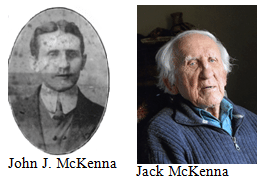
Primary source: raw/Jack McKenna (b. 1918) and Sue McKenna | Irish Life & Lore.html — saved May 2026 copy of the Irish Life and Lore product page for recording CD191602-129, including the photo of John J. and Jack McKenna reproduced above. Local recording and transcript: raw/jack-sue-mckenna-listowel.mp3, raw/jack-sue-mckenna-listowel-transcript-2026-05-26.md, and raw/jack-sue-mckenna-listowel-transcript-2026-05-26.json. Maurice O'Keeffe's interview with Jack McKenna (b. 1918) and Sue McKenna of Parknadoon, Listowel; "1916 Rising Oral History Collections" series. Secondary sources: Mary Cogan, "McKennas of Listowel", listowelconnection.blogspot.com, 13 November 2011 (the Jeremiah McKenna business-line foundation post); raw/kilshenane-grave-and-listowel-descendants-2025.md.